


Artificial intelligence has moved from being an emerging technology to becoming an important part of modern business strategy. Companies are using AI tools to automate repetitive tasks, analyze data, improve customer experiences, generate content, support employees, and make faster decisions.
However, businesses often face an important question: Should you invest in custom AI solutions or use an existing AI software product?
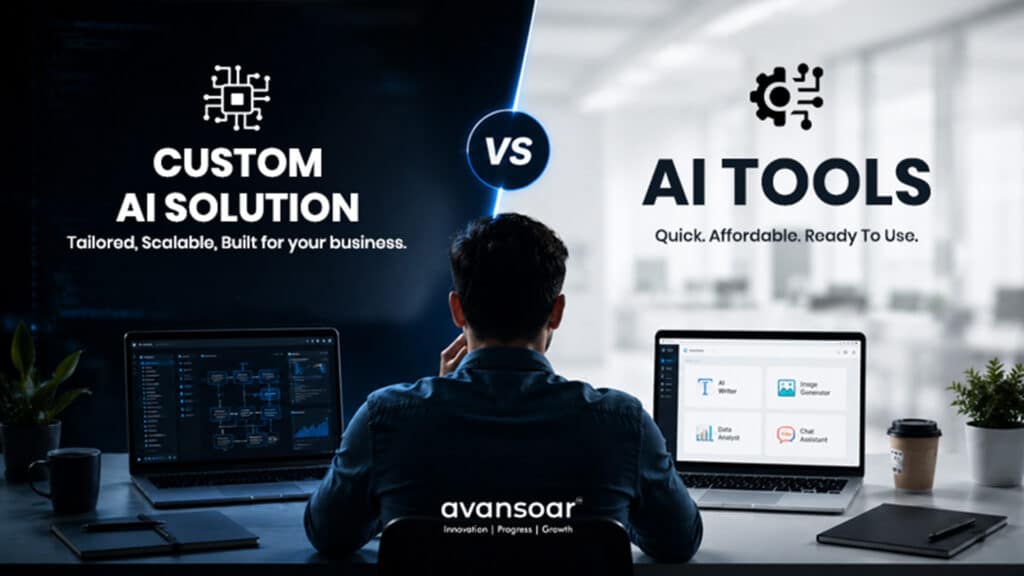
Off-the-shelf AI tools are ready-made solutions designed to serve a broad range of users. Custom AI solutions, on the other hand, are developed specifically around a company’s processes, goals, data, and technology environment.
There is no universal answer. The right choice depends on your business objectives, budget, technical requirements, scalability needs, and the complexity of the problem you want AI to solve.
Let’s compare both approaches.
What Are Custom AI Solutions?
Custom AI solutions are artificial intelligence systems developed specifically for a particular business or use case.
Instead of adapting your processes to an existing tool, custom AI development allows the technology to be designed around your business requirements.
A custom AI solution can include:
- AI-powered business automation
- Custom recommendation engines
- Intelligent chatbots and virtual assistants
- Predictive analytics
- Document and data processing
- Computer vision applications
- Natural language processing
- AI-powered search
- Fraud detection systems
- Intelligent workflow automation
- Industry-specific AI software
For example, a company with a large internal database may require an AI assistant that can securely search and analyze its proprietary information. Rather than relying entirely on a generic AI tool, the company can develop a solution designed around its own data and workflows.
What Are Off-the-Shelf AI Tools?
Off-the-shelf AI tools are pre-built applications that businesses can start using with minimal development.
These tools are generally designed to solve common business problems and can be useful for companies that need quick access to AI capabilities.
Examples include tools for:
- Content generation
- Customer support
- Marketing automation
- Data analysis
- Image generation
- Transcription
- Email automation
- Productivity
- Sales assistance
- General business automation
The biggest advantage is speed. Businesses can usually sign up, configure the tool, and begin using it without building an AI system from scratch.
Custom AI Solutions vs AI Tools: Key Differences
The biggest difference between these approaches is customization.
| Factor | Custom AI Solutions | Off-the-Shelf AI Tools |
|---|---|---|
| Customization | Very high | Limited to available features |
| Development Time | Longer | Faster |
| Initial Cost | Usually higher | Usually lower |
| Scalability | Designed around business needs | Depends on provider |
| Integration | Highly flexible | Depends on APIs/integrations |
| Data Control | Greater control | Depends on vendor |
| Security | Can be designed specifically | Vendor-dependent |
| Maintenance | Requires ongoing development | Usually vendor-managed |
| Competitive Advantage | Potentially high | Usually limited |
| Best For | Complex, specialized needs | Common, immediate needs |
1. Customization and Flexibility
One of the biggest benefits of custom AI software is flexibility.
Off-the-shelf tools provide predefined features. While many platforms offer customization options, you are ultimately working within the capabilities of the product.
Custom AI development gives businesses significantly more control.
You can determine:
- How the system works
- What data it uses
- Which workflows it supports
- How it integrates with existing software
- What outputs it produces
- How users interact with it
This can be particularly valuable when your business has unique processes that generic AI tools cannot properly support.
2. Cost Considerations
Cost is another major factor.
Off-the-shelf AI tools typically have lower initial costs because the software has already been developed. Many operate through monthly or annual subscription models.
Custom AI solutions generally require a larger upfront investment because they involve planning, development, testing, integration, deployment, and ongoing optimization.
However, businesses should look beyond the initial price.
A customized AI system may provide better long-term value when it:
- Automates complex processes
- Reduces manual work
- Improves operational efficiency
- Integrates multiple systems
- Reduces dependence on multiple software subscriptions
- Creates new revenue opportunities
Therefore, the right question is not simply “Which option is cheaper?”
It is “Which option delivers better long-term value for my business?”
3. Scalability
As a business grows, its technology requirements can change.
An off-the-shelf AI tool may work perfectly for a small team but become restrictive as the organization develops more complex requirements.
With custom AI solutions, scalability can be incorporated into the architecture from the beginning.
Businesses can build AI systems that are capable of supporting increasing:
- Users
- Data volumes
- Transactions
- Workflows
- Integrations
- Business locations
This makes custom AI development particularly attractive to businesses with long-term AI adoption plans.
4. Integration With Existing Systems
Modern businesses rarely operate using a single software platform.
They may use CRM systems, ERP platforms, accounting software, websites, mobile applications, databases, marketing platforms, and internal business applications.
Off-the-shelf AI tools may offer integrations or APIs, but compatibility can vary.
Custom AI software can be developed to work specifically with your existing technology ecosystem.
For example, an organization could develop an AI system that connects its CRM, customer support platform, internal database, and reporting system into a single intelligent workflow.
5. Data Privacy and Security
Data is one of the most important considerations when implementing AI.
Businesses dealing with confidential customer information, financial data, intellectual property, or sensitive internal information may require greater control over how their data is processed and stored.
With custom AI development, security requirements can be incorporated into the architecture and development process.
However, this does not automatically mean that custom AI is always more secure. Security depends on how the system is designed, implemented, hosted, monitored, and maintained.
Businesses should carefully evaluate the data policies and security practices of any AI vendor before adopting an off-the-shelf tool.
6. Speed to Market
This is where off-the-shelf AI tools have a significant advantage.
If you need an AI-powered writing assistant, transcription tool, chatbot, or basic automation solution immediately, an existing product can often be deployed much faster than developing a custom system.
Custom AI development takes more time because the solution must be:
- Planned
- Designed
- Developed
- Integrated
- Tested
- Deployed
- Optimized
Therefore, companies looking for immediate results may benefit from starting with an existing AI tool.
7. Competitive Advantage
Generic AI tools are available to many businesses.
That means competitors can potentially use the same technology.
Custom AI solutions can provide a stronger opportunity for differentiation because they can be built around your proprietary processes, business data, customer requirements, and operational expertise.
For businesses where AI is expected to become a core part of their competitive strategy, custom AI software may therefore provide greater strategic value.
When Should You Choose Off-the-Shelf AI Tools?
Off-the-shelf AI tools can be the better choice when:
- You need a solution quickly.
- Your requirements are relatively standard.
- You have a limited initial budget.
- You want to test an AI concept before investing heavily.
- You don’t need extensive customization.
- Your existing systems already integrate with the tool.
- AI is supporting your business rather than becoming a core product.
For many small businesses and startups, starting with existing AI tools can be a practical way to experiment with AI before moving toward custom development.
When Should You Choose Custom AI Solutions?
Custom AI solutions may be more appropriate when:
- Your business has highly specialized requirements.
- Existing AI tools cannot solve the problem effectively.
- You need deep integration with internal systems.
- You handle proprietary or sensitive data.
- You need complete control over workflows.
- Your AI system is expected to scale significantly.
- AI is a core part of your product or competitive strategy.
- You want to create a unique customer experience.
In these situations, the additional investment in custom AI development can potentially deliver greater long-term value.
Can Businesses Use Both?
Absolutely.
The choice does not always have to be custom AI vs AI tools.
A hybrid approach can often be highly effective.
For example, a business might use existing AI tools for content creation, employee productivity, and basic automation while developing a custom AI platform for its core business processes.
This approach allows companies to gain immediate benefits from existing technology while investing strategically in areas where customization provides the greatest advantage.
How to Decide Which AI Approach Is Right for You
Before selecting a solution, evaluate these five questions:
1. What problem are you trying to solve?
Clearly define the business problem before selecting the technology.
2. Is the problem common or highly specialized?
Common requirements can often be handled by existing AI tools, while specialized problems may justify custom development.
3. How important is scalability?
If you expect significant growth, consider whether your chosen solution can support future requirements.
4. How sensitive is your data?
Evaluate your privacy, compliance, security, and data-control requirements.
5. What is the expected ROI?
Compare the total cost of implementation with potential savings, productivity improvements, revenue opportunities, and strategic benefits.
Final Verdict: Custom AI Solutions or Off-the-Shelf AI Tools?
There is no one-size-fits-all answer.
Off-the-shelf AI tools are ideal when you need fast, affordable access to established AI capabilities. They can help businesses experiment with AI and automate common tasks without significant development investment.
Custom AI solutions are better suited to organizations that need specialized functionality, deeper integrations, greater control, scalability, or a unique competitive advantage.
The best strategy is to evaluate AI based on your actual business requirements rather than choosing technology simply because it is popular.
For businesses with complex requirements, custom AI development can transform AI from a generic productivity tool into a strategic business asset.
Avansoar helps businesses explore technology-driven solutions designed around their specific goals, processes, and growth requirements. With expertise across software development and digital transformation, the right AI strategy can be planned around what your business actually needs rather than forcing your processes into a one-size-fits-all solution.
Conclusion
AI adoption is no longer simply about choosing the most advanced tool available. It is about choosing the technology that best supports your business objectives.
Off-the-shelf AI tools provide speed, affordability, and convenience, while custom AI solutions provide flexibility, control, scalability, and opportunities for differentiation.
For simple and common tasks, an existing AI tool may be all you need. For complex business challenges and long-term AI strategies, custom AI development can be a more powerful investment.
The right choice ultimately depends on your business goals, data, workflows, budget, scalability requirements, and expected ROI.
Frequently Asked Questions
1. What are custom AI solutions?
Custom AI solutions are artificial intelligence applications developed specifically for a company’s unique requirements. They can be designed around proprietary data, business processes, workflows, integrations, and customer needs.
2. Are custom AI solutions better than AI tools?
Not always. Custom AI solutions provide greater flexibility and control, but they usually require more time and investment. Off-the-shelf AI tools can be better when businesses need quick and affordable solutions for common requirements.
3. What are the benefits of custom AI software?
The major benefits of custom AI software include greater customization, flexible integrations, improved scalability, stronger control over workflows and data, and the ability to create AI capabilities that are tailored to specific business requirements.
4. How much does custom AI development cost?
The cost depends on factors such as the complexity of the AI solution, data requirements, integrations, features, infrastructure, security requirements, and development time. A detailed assessment is usually needed before determining an accurate budget.
5. Can a business start with an AI tool and later develop custom AI?
Yes. Businesses can start with off-the-shelf AI tools to identify useful applications and understand their requirements. As AI becomes more important to their operations, they can transition selected processes to custom AI solutions for greater control, scalability, and customization.
